Showing posts with label news. Show all posts

Friday, October 16, 2015

10 years later: Remembering a brassy, bawdy bud

Published originally in The News & Reporter, Dec. 2 , 2005

I once boasted I never suffered writer's block.
I was young then, and I know the truth now.
Sometimes the words don't come.
Words define reality and allow it to be shared by others who don't experience it. So if you write down some real thing you lived but tried to block out, you can't hide from it. You think to share it, hoping to ease your pain, but you also know, when it is there, printed in ink, in your own words, you won't be able to hide from it anymore.
It's been almost a month since I heard, and on this topic, the words just wouldn't come.
A few months back, I wrote about my first real boss in this business, Mardy Jackson, as part of a column boasting about how wonderful a profession journalism is.
Mardy Jackson gave me my first reporting job. She took a chance hiring me, because my freelance work at the time meant I was struggling, not having gotten a full-time gig at a "real" paper.
Through me, she showed the people who ran that newspaper company the truth of an aphorism much quoted but not always followed -- "Take care of the news, and the ads will take care of themselves."
She hired me to be a professional writer for her, to take care of the news.
As I got better at doing that for her, the ads started taking care of themselves.
She was always, always, always trying to teach me. She'd teach me with a tale of her hard life, a brutal job evaluation, a lede paragraph so slashed up it looked like Freddy Krueger got to it, or even a dirty joke.
When I first got on board the paper in Cheraw, she was involved in a debate with others in the company. She was publisher of the paper, but she didn't join the Rotary Club or the Chamber of Commerce board. She felt it would be a conflict. If she heard something one of those civic groups didn't want out yet, she would, hypothetically, be torn between her oath to the group and her duty to the readers.
But she was all about her readers, first and always, so she would never really have been torn. Instead of being a hypocrite, instead of pledging to work with a group that might ask her to keep a secret she knew she wouldn't, shouldn't keep, she didn't join.
She'd heard all the "get involved in the community" arguments from the people in such groups. Some, she knew, sincerely believed their groups were the best things for the community, and she respectfully disagreed, for herself.
She also knew others wanted to co-opt her, to join the groups as a way to muzzle her. She was on to them from the get-go.
She told those leaders, told others in our company and told me, privately, that you don't need to get involved in those groups to be involved.
Like me, she was raised a Catholic and knew all about guilt. But she wouldn't let anyone make her feel guilty because she wasn't involved the way they expected her to be involved.
She taught me that working for a paper, one that brings real news, is the ultimate community involvement. It is perhaps the best way to improve your community.
You hold up a mirror to your community, let it see itself for what it is. If there is a blemish here, the community can fix it. If there's a bright spot here, the paper can shine a light on it for others outside to see. The good and the bad, both are in a community newspaper.
Mardy had resigned before I moved from Cheraw to Barnwell. But we stayed in touch and I got to apply her teachings.
In Barnwell, I was challenged by several to "get involved" in civic groups or serve on this or that board. One mean little fellow tried to trip me up as those others had tried to trip up Mardy.
Get involved, he said. What he meant was don't ask critical questions until you get involved the way he defined involvement. Don't fret being asked to keep a secret from your reader if necessary, he said.
My answer was at the ready because of Mardy.
I told him I couldn't serve because I would be asked to keep secrets from my readers. That, I told him, would break the promise I made — I don't keep secrets from my readers.
He didn't get it. I went further, and said if he was a real community leader, he ought to make the same promise. Don't keep secrets from your constituents.
He didn't like that, but Mardy would have roared with laughter, loving it
She taught me another lesson recently, a hard one for me to take.
She quit the Cheraw paper years ago, but she didn't move away. She wrote a novel or two, tried to get them published, freelanced here and there, farmed, did some records checking and private investigations.
She lived a pretty interesting life from a place where those afraid of the truth had called her an outsider just because she had refused to join "those" groups as publisher of the paper.
She was involved in her community in the way she chose. As publisher, she did it by providing information. After journalism, she was as involved as ever.
When the need arose, she took a leading role.
At some point in the last couple of years, some nameless bureaucrat made a decision to move a line on a map. Suddenly, Mardy didn't live in a fire district anymore.
We'd both written about rural fire protection, and she knew the dangers immediately. Even if she never had a fire in her little trailer, she knew her insurance was going to skyrocket.
The problem didn't just affect her. It changed things for a whole bunch of her neighbors, so she helped those neighbors organize and take action. She wrote grants that helped them form a new volunteer fire department, buying land, building a station and most importantly, paying for a new fire truck.
They had a barbecue a few weeks back at the department. They put her name on the truck.
The barbecue was held in her memory. Early in the summer, she was diagnosed with cancer. Before I heard, I noticed she wasn't responding to the infrequent but regular e-mails I sent her.
I later learned she was having such a hard time of it she stopped seeing all but her immediate family.
A few weeks back, I went to Cheraw to do a job for a newspaper group, but didn't take the time to see her. She died a few days after my trip.
I had no idea it was as bad as that.
I am perplexed by many things in her passing. She was a health nut who never smoked, yet somehow got lung cancer that killed her just a few months after her diagnosis. She was just in her 50s. It's unfathomable.
Perplexed by those facts, I am sure of others.
She gave me a chance when no one else would. I thanked her many times for that chance, but never enough.
I am also sure that she has taught me that final lesson, again one about community involvement.
She's now shown me that, if I ever decide to give this profession up, I can still be involved. You don't have to be in the steady group, or even at a newspaper, to make a difference, Mardy's final involvement, helping create a fire department, is going to save people's lives.
I am proud of being a journalist and being involved in a community by informing it. I truly can't imagine not working at a newspaper.
But when I remember that it took me almost a month to write about Mardy Jackson, my mentor, my friend, my bawdy, brassy Madonna of information, I see that maybe, someday, I might have to leave the profession.
Because sometimes, the words don't come.

Saturday, August 9, 2014

UPDATE 2: Everything is better with Bacon

UPDATE 2: Rick's obit. HYSTERICAL. Read it here, or below.
NORTON!


The best boss I ever had, has died.
One of the best friends I ever had, has died.
A man who took to mentoring me and sometimes treated me like a stupid son, has died.
And one of the funniest human beings on the planet has died.
Rick Bacon.
A lot of time, people look around and say, "I owe him everything."
It's often just that. Something people say.
He plucked me out of one rural corner of South Carolina where I was just a reporter, asked me to come to his papers in Barnwell and Allendale and to do what I do best. Kick ass, in a journalistic sense.
He gave me generally free rein, and he always backed me up. Except for a couple of times, including the time he brought me into his office, told me to close the doors and then asked "Who the f--- I thought I was."
He was the last person to pay me a fair wage straight up, though not the last person to try to do so. So I have a toy or two, thanks to him.
But he had previously hired as an editor a woman named Patricia Larson. Transferred her to be a publisher in Winnsboro before I moved to Barnwell. But she came to Barnwell once a week for production work.
The guy who, inadvertantly, arranged for me to meet my wife, has died.
Without Rick, I guess I don't have Patricia. Without Rick, I guess I don't have our son as well.
He was always there for me, with a joke to cheer me up, with advice about a job that maybe wasn't going so well, to offer a reference for a new job, whatever kind I'd like. The truth, if that would help. A hedge, if it would not.
His lessons were very quick and deadly.
I don't remember when I talked to him after 9/11, but I was going on about the attack, about the Twin Towers, about how my cousins were nowhere near and of course safe.
Then he said, "Candy's sister and brother-in-law are OK."
Brought it quickly home. Candy's sister and brother-in-law lived in or around Washington DC. He was in the military and had, I think, a job at the Pentagon.
9/11 wasn't just about the attacks on New York, but being a native New Yorker, I see the attacks that way.
He would ask a question, you'd start talking and when he could get a word in edgewise, he'd say, "Let me ask that question in a different way." Then he'd ask that question the exact same way. to drive home the point. Listen.
I was remembering some of his stories. Many true. There was the radio host on the religious station in Burnsville, NC, where he worked, who, when reading the Bible and came across a word he did not know, would simply say, "Big word."
His BBQ hog call he used to do.
Sometimes he just got great moments out of pure luck. His last day on the job, when he left Barnwell to go to Lake City, Fla., he was just about to leave when a song came on the radio.
This song --

He came back for the first verse, than twirled and danced his way out the door. Even some of my co-workers who were cursing his name a month before were crying.
And laughing, at his timing and his little spin move.
Rick told me once that he sometimes stopped calling people who said they were friends, just to see how long it took for them to call with something other than a request for him to be a reference. It was a test.
I think that was part of the reason behind his abandonment of Facebook a while back. We have "friends" on Facebook. Friends we don't talk to in the real world anymore. It's too easy to count your friends and not be a friend you can count on.
I did my best to stay in touch. Usually we would have email exchanges, and that would prompt him to send me a message, in which he asked, always, for my wife's phone number.
I think he wanted to hear her voice.
In February, he asked me about my other favorite boss of all time, Mardy Jackson. Asked me if she had died of cancer. I am wondering now if that was a roundabout way of preparing me for what came in April.
April 14.
I have some work to do.
I received word a couple of weeks ago that I have lung cancer.
Met with the radiation oncologist Friday to decide on a regiment.
Meeting with chemo oncologist this Wednesday.
I’ve had several tests, but we are going to do another c/t scan, a pet scan, a brain scan and another biopsy to see if there has been any ‘spread.’
If not we have a curative plan. If so, it’s just a treatment plan.
I have a good attitude and am going to do everything they ask me to do to whoop it’s ass.
Fighting with cancer jokes of the week.
This weeks:
Why did the cancer patient cross the road?
So he could be hit by a truck.
Keep smiling.
You may call me:
Chemo-Sabe

I responded, rambling as a jerk, but trying to make him smile. I said we'd pray, of course, but I would do anything to help, particularly anything that would get me named his heir.
Little chance of that, though.
Ten more days passed, and he started a little column, for friends, that he would NOT post on the Internet as a blog, but just send to those he wanted to send it to. The title was based on a movie we both loved. From Miracle Max in the Princess Bride, he called it, "Have Fun Storming the Cancer."
There were to be multiple installments in which he detailed his attempts to kill cancer with humor.
There was just one more.
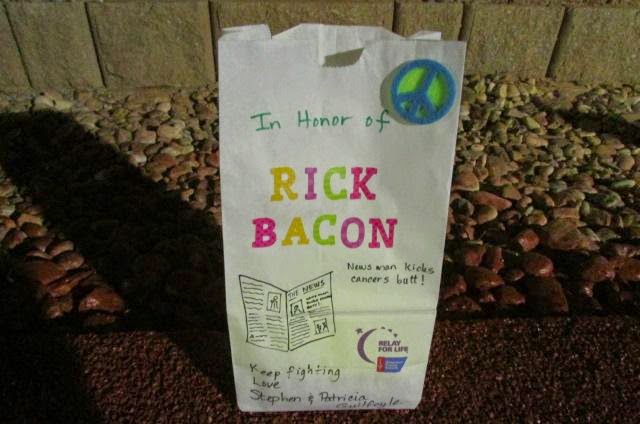
My sister was doing Relay for Life, because Dad died from his breast cancer returning last year. And we got a luminary for Rick. I emailed him a picture of it, and we talked back and forth via email a bit.

He sent me back a picture of that luminary posted above his desk at work. I also saw a picture of a county highway sign, that said, Yancey County, Shallow Gene Pool, No Diving.
He said someone made it up based on one of his jokes.
I sent him an email about a friend who got a job in the same building where he worked. As I expected he would, he told me to tell her to drop by.
But I also told him about these episodes of The People's Pharmacy on NPR devoted to cancer that he should probably check out.
He told me he had some unexpected pain.
"I think you are too worried about me," he wrote. That was July 21.
Not enough, apparently.
There was one more email, but it was totally nondescript.
Since he knew her first, it's only fitting that his last words to us went to Patricia, albeit to her voicemail.
"Mrs. Guilfoyle, this is Rick Bacon," he says, his voice sounding a little weak, a little shaky. "And I just wanted to tell you that's a heck of a Pope you've got now. He gives me faith that ... maybe all religion isn't all totally crap. Just wanted you to know that. Have a good day."
That was July 30. I get a kick out him calling her Mrs. Guilfoyle, for one thing. The pause after "He gives me faith that ..." makes me wonder. Was he, as normal, just going for the joke that followed? Or was he thinking about something else, but reverted to type because he wasn't quite ready to admit it to others.
Patricia told me she played phone tag trying to get back with him a bit.
That was, we learned, the day he learned that the treatment plan wasn't working. On Friday, Patricia got a few messages, one on Facebeook and one from Rick's son Jon, calling on Rick's cell phone, missing her, of course, but letting her know what happened the night of Aug. 7.
She called me, around 1:30, 2 on Aug. 8 to see if I had heard on my own. As I was just waking up to go to my night-time job, I had not.
Everything is better with Bacon. The afterlife, therefore, is better.
I was, and remain, stunned.

From the second linked story below. "A “Celebration to Remember” that Bacon planned before his death is scheduled from 1-3 p.m. Aug. 23 at Pier 41 Seafood in Lumberton. Bacon asked people not to waste money by sending flowers. Instead, he suggests those who want to remember him do a random act of kindness or donate to their favorite charity."

Story on Rick's death in the Richmond County Daily Journal.

County mourns the loss of Rick Bacon, from the Richmond County Daily Journal.

His obituary, in case the link doesn't work.

Richard Norton (Rick) Bacon 

  |   Visit Guest Book

LUMBERTON — Richard Norton Bacon (Rick) of Lumberton has left the building. His friends will tell you he's in a better place. The rest will say they can smell the Bacon burning. He is stress-free and at peace.
The curtain came down on Thursday night at Southeastern Regional Medical Center.
He is survived by his loving wife of 29 years, Candace Smith Bacon. He is also survived by his son Jonathan Bacon and wife Beth of High Point; daughter Melody Kearse of Rock Hill, S.C., and son Bryan Kearse and wife Liz of Raleigh. Five grandchildren made his life better with their visits.
Rick loved dogs. Trixie, Richie, James Brown Beans and Mr. Woo were the last in a long line of hairy hogs that shared his bed and his affection.
He was born in Auburn, N.Y., July 16, 1947, the son of the late Elizabeth Dunster Bacon and Frederick Neil Bacon. He was also predeceased by a brother, Ted.
He drifted south from upstate New York in 1962 to the mountains of North Carolina, where he graduated without honors in the class of '65 at East Yancey High School. After one undistinguished year at the University of North Carolina-Chapel Hill, Rick enlisted in the United States Air Force. He became a Morse intercept operator and spent two and a half years overseas in Turkey and Italy.
After another failed college attempt at Mars Hill College, Rick got his start in media at WKYK radio in Burnsville, N.C. From radio it was on to newspaper, where Rick spent 26 years publishing newspapers, moving from state-to-state looking for a town that would keep him. From Spruce Pine, N.C. to Barnwell, S.C. to Lake City, Fla., he survived buying a Buick LeSabre (the official car of geezers) and a heart attack that convinced him it was time to leave Florida unless he wanted to die young. He headed back to North Carolina to live and work in Rockingham and Lumberton, where he had a good life.
Rick was a Rotarian for over 25 years. He served as president of the Rockingham Rotary Club in 2012-13 and was proud of the work that Rotary did in the community and around the world. He was a two-time Paul Harris Fellow.
In March of 2014, Rick was diagnosed with lung cancer. He celebrated with yet another trip to a Cincinnati Reds game. If you knew Rick, you knew that he was a loyal Reds fan since the late '50s without ever living a day in Ohio. He often said, "There's no explaining taste."
Cremation will take place at the family's convenience and his ashes will be kept in an urn, passed from family member to family member until no one can remember what's in the jar.
Everyone who remembers Rick is asked to celebrate his life in their own way; telling a 'He wasn't so bad' or 'What an ass' story of their choosing. Boiled shrimp and a beverage of your choice should be part of any celebration.
Instead of flowers, Rick would hope that you will do an unexpected act of kindness for some less fortunate soul. Rick liked to buy food for the car behind him in the drive-thru lane, or a meal for a military couple (if he could do it without them knowing who paid). That's a lot cheaper than flowers.
A memorial luncheon in Rick's honor will be held at Pier 41 in Lumberton on Saturday, Aug. 23, 2014 from 1 to 3 p.m. at Pier 41 Seafood. Adult beverages will follow at widow Candy's house on Camellia Lane. To the crooks reading this: We left an armed guard and the four killer dogs home from the luncheon. If you come to steal, they will hurt you.​


Wednesday, April 27, 2011

The Birther Issue: Why it's NOT OVER

10. Sure, the birth certificate shows Barack Hussein Obama II was born in Hawaii. But how do we know this is the same guy? Have you been with him every moment from 1961 to present?

9. Sure, the birther thing started out with people who thought he wasn't a citizen BECAUSE he was born in Hawaii, but Hawaii wasn't yet a state, so ... But a full examination reveals that he isn't a citizen because Hawaii isn't REALLY a state. They just brought it in so we could have an even number of stars on the flag.

 8. BHO. What kind of initials are BHO? That's presidential disqualification right there.

7. His ears are too big for a president. (Sure, George Washington's ears were bigger, but he hid them behind a powdered wig.)

6. He's too confusing to be president. Every time he says, "Let me be clear, " he isn't clear. It's very confusing.

5. What kind of a name is BARACK? Jewish? Don't want to be seen as anti-Semitic, but Israel has paid people to spy on the U.S. Is he an anchor baby for Tel Aviv?

4. As a side note, where was Joe Biden born? Can you PROVE it?

3. Kids who want to grow up to be President are not allowed to leave the U.S., and Barry Soerto lived in Indonesia for like, a LONG time.

2. There was a temporal causality loop: (See Star Trek: The Next Generation Season Five, Epipsode 20, Cause and Effect for fuller explanation) over Hawaii that day, and he was actually born 20 years earlier, then delivered back in time to his mother, so he's actually 69 years old, but born in the TERRITORY of Hawaii.

1. Anybody can make up any piece of paper on the Internet, get it certified by state officials in Hawaii

But the real reason it isn't over yet ...

MORONS DON'T STOP BEING MORONS WHEN PRESENTED WITH FACTS.

Thursday, August 19, 2010

It's not at Ground Zero

This issue is a tempest in a teapot.
A friend said the "mosque" is 300 feet from Ground Zero. It is not.

I have added color to this graphic I found at http://www.prisonplanet.com/articles/april2008/041008_hit_piece.htm.
That is a map of that part of the city at the time of the attack.
If you look, the only way you can say it's two blocks is if you count from the corner of Church and Vesey. In addition to the six buildings on that block, there was a big plaza in the middle.
The Towers were on the other side from the spot most are using to justify the "two blocks" description. They were in the far corner.
So just pretend you are standing on that block, on Church Street. Place yourself in front of the Millenium Hotel, also marked in blue.
How far is it?
The Millennium Hilton's address is 55 Church Street, New York, NY. Do a Google map directions search for walking directions (because some of the streets are one-way or closed because of construction), and it is 2/10ths of a mile from "Ground Zero" to 51 Park Place.
That's 1,056 feet.
If you are on Church Street, looking uptown, you have to walk almost half of the Ground Zero block. You pass Fulton Street on your right. Then you come to the corner of Church and Vesey. You then walk another block to the corner of Church and Barclay. You then walk another block to the corner of Church and Park. You turn left and go down most of that block and you will see, on your left, the old Burlington Coat Factory store. Huge signs still on the building.
That is, in the reality of walking in New York, actually more than four blocks.
It is absolutely not a Ground Zero Mosque.
Some say it is not a mosque. But the tempest in a teacup begins with the idea that it is at Ground Zero.
Do street level view and here's a couple of glimpses of what you'll get -- 

View looking downtown from intersection of Park and Church.
View looking crossdown, toward Hudson River, from same intersection.

Monday, April 5, 2010

Newspaper brings home 13 SCPA awards, five first places

The News & Reporter took home 13 awards, including five first place awards, in the latest S.C. Press Association annual competition, with some staff members showing continued excellence in a couple of areas.
Sports Editor Travis Jenkins took home the first place award for writing the best sports columns for the third consecutive year.
"That's an actual hat trick, scoring three consecutive 'goals' like that," said Editor Stephen Guilfoyle of Jenkins' award. "It's the top prize for sports writers, so he's been the best at what he does for three years running now."
That competition was for papers that come out two and three times a week.
The judge said of his entry, "Nice tribute column to a lady who volunteered to send in race results. Feature column on singing fans made me smile, and writer offered a good opinion piece on the Bulldogs."
Guilfoyle won the Harris Award for Editorial Writing. In that competition, he went up against all the non-daily newspapers in the state.
It is the fifth time he's won the award in his career and the third time since joining The N&R in 2004.
"This newspaper does exactly what it should -- take stands on local issues in thoughtful, well-written editorials that make good cases for newspaper’s positions," the judge wrote.
The editorials considered were, "Picking on the poor," about Gov. Mark Sanford; "Should he have mentioned it?" about former Superintendent Larry Heath; and "County wrong to threaten to sue," about the county threatening to sue county residents during the Fort Lawn situation.
Guilfoyle also won first place in Profile Feature Writing or Story for 2/3 Times weekly newspaper for "Reserved Seating: Friends remember longtime officer," a story on community reaction to the death of longtime Chester Police Lt. Tommy Harrison.
The judge said, "Powerful, well-written story that leaves an impact with readers."
Guilfoyle also won a first place award for Page One Design at 2/3 Times a week papers.
"Nice use of graphics, photos and other elements," the judge wrote. "Designer has a gift for packaging lead story.
He also won the first and second place awards for Enterprise Reporting at 2/3 Times a week newspapers.
The first place award was for the story "'08 Brazil trip filled with work," on an economic development trip to Brazil.
"Interesting probe," the judge wrote of that story.
The second place award was for "$500 million incinerator," in which The N&R broke the news of the Covanta Energy project.
Jenkins also won second place awards for:
• Sports Enterprise Reporting, also an All-Weekly award, for coverage of where to play high school football's weekend of champions;
• News Headline Writing at 2/3 a week papers, and
• Spot Sports Story writing at Weekly 2/3 Times for "Downey raises the roof";
as well as third place awards for Sports Action Photo and Sports Feature Photo.
Great Falls Editor Nancy Parsons won a third place award for Lifestyle Feature Writing at 2/3 Times a week papers for "Eli touches bases and hearts."
She, Guilfoyle and Jenkins shared a second place award for Reporting In-Depth at 2/3 times a week papers for coverage of the school consolidation issue.
In all, Jenkins won seven awards, Guilfoyle won six, with Parsons getting two, including the shared award.
Jenkins' seven total awards were the most won by any journalist in the non-daily ranks.
"One thing the awards show is that we have to do a lot of different things each week at The News & Reporter," Guilfoyle said. "Travis excels at sports writing, but he also pitched in and wrote some news headlines, and those turned out to be award winners. He has always been an excellent photographer. Nancy won not just for a feature in her beloved beat of Great Falls, but also for working with the team to cover the county-wide news story that consolidation became."
"Being recognized by your peers is always good," said Publisher Buddy Aultman. "But when the economy creates an understaffed situation like we have at The News & Reporter, the awards mean even more. In recent years, we have had fewer people doing more and yet we managed to have a good 2009. The editorial awards are like icing on the cake."
In the past three years, Jenkins has won five first place awards and 17 total awards, making him one of the most honored journalists in the state.
In the past three years, Guilfoyle has won eight first place awards and 13 total awards.
In the past three years, Parsons has won five awards, including one first place.
The paper has won 68 awards in SCPA contests since 2005.
Two of The N&R's sister papers in South Carolina also won awards. The Lancaster News won seven awards including two first place awards. The Pageland Progressive-Journal won one.

Friday, April 2, 2010

What she saw on Good Friday

My wife just pasted this on Facebook:
Patricia Larson Guilfoyle: Just saw someone playing Jesus walking down Hwy. 160 in Fort Mill. it's Good Friday, all right!
I, being a smart ass, had a reply at the ready: How do you know it was someone playing Jesus? Could it have been ... Himself?

Remember what happened when the Irish priest got through to the Vatican, told the Pope, "I'm not crazy, but the Lord Jesus himself has returned and he's walking down the main street. Tell me what to DO!"
And the Pope says, "Look busy."

By the way. I like Jesus' sneakers.

Saturday, February 13, 2010

My wife's new job

I'm going to have to update the home page of my old website, that this blog is someday to replace.
It has the Fort Mill Times on it.
Anyway, Patricia is now editor of The Catholic News & Herald, the newspaper of the diocese of Charlotte.
She sent me an e-mail about a "daunting" aspect of her new job.
She had to edit a piece from 1750 words to 450. So you ask, "So?"
The writer is the Pope. 
I e-mailed her back, saying, "What's so daunting about editing the Bishop of Rome, the Vicar of Jesus Christ, the Successor of the Prince of the Apostles, the Supreme Pontiff of the Universal Church, the Primate of Italy, the Archbishop and the Metropolitan of the Roman Province, the Sovereign of the State of Vatican City, the Servant of the Servants of God?"
Everybody needs an editor, my old senior editor Phil Hudgins used to write. 
I mean, the pope doesn't write his column while sitting on the Holy See, see?
(That would denote he is speaking, or writing, ex cathedra, or infallibly.)

Anyway, it was tough for her to leave her old gig behind.

Patricia's passion was the paper

It was with a lot of soul-searching that my wife, Patricia Larson Guilfoyle, decided to take another job.
She will probably add this letter to the things for which she wants to kill me, but she’s also, to a fault, someone who will keep things inside way too much, not wanting a fuss.
More than 11 years ago, she came to Fort Mill to take on the position of as publisher-editor of the Fort Mill Times. She thought it a good job, a step up from where she’d been. She thought the paper needed some help, and she had the skills to do what needed to be done. It was within her professional reach.
One of the things she thought the paper needed was a restored sense of presence in the community. To do that, she threw herself into several different activities and groups, including the Fort Mill Rotary Club, the chamber, the downtown association. She kept herself pretty busy.
She brought the paper around financially, and advanced it to where it was profitable, and also again one of the most awarded, respected large weeklies in the state of South Carolina. She ended up in more than one leadership role in those clubs, and also worked her way up to becoming the president of the S.C. Press Association. All at a very young age, I might add.
If one simply looks at her resume, she is one hell of a journalist and one hell of a businesswoman.
But her job in Fort Mill, from the earliest stages, became more than just a job.
She took on other assignments from her company because her company needed her skills. She did all those other jobs to the best of her abilities, and she did them well.
But it was always the Times and Fort Mill Township that had her heart.
Over the years she would introduce me to several people. Old guys, mostly. They all flirted with her; she tried her best to flirt back. Never anything serious in the conversation as I watched, but once they left, she’d tell me of the respect she held for those men. They are of that Greatest Generation and they are the men who built Fort Mill into something. Many are forgetting those men. But she never did, and always made a point to get them in the paper, to point them out to me.
It’s without a doubt, if she could have remained simply as the publisher of the Fort Mill Times, and been able to do her job the way she wanted it done, the difficult decision she made to leave would probably have been impossible. But her decision also has a lot to do with our family and her desire to find more time to spend with our son.
So, she made a hard choice. She worked about 60 hours her last week with the Times and parent company McClatchy, finishing up Jan. 29. She started her new job Feb. 1.
Because she won’t, I would like to let you know, on her behalf, how much she loved her time with the paper, how important all the readers were to her, and how much she loves Fort Mill. She’ll miss it, greatly.
Her new position is in North Carolina, but that doesn’t mean we’re leaving.
We’re staying right here, because she loves it, and she’s taught me to love it as well. This is a place that gets under your skin, in a good way.
On her behalf, I’d like to thank the readers of the Times for 11great years.
Stephen Guilfoyle

Wednesday, February 10, 2010

History does repeat itself

Years ago, when I first started working in Chester, and we got more aggressive about getting scoops and posting scoops on the web and taking a little journalistic pride in those scoops.
We got busy. By the time I was named editor, I had created my in-home "breaking news list."
And I got a request from someone to join that list. It was our competition. I liked that. What a hoot.
I might still have the e-mail somewhere. It's the little things like that in life that make you smile, most days. So it was probably a keeper. But we made a little house ad out of it, that we ran occasionally.
Said something like, "When your competition wants to be on your breaking news list, you know you're Chester County's No. 1 news source." Something like that. And it instructed readers on how to join the list.
They aren't really covering Chester County anymore. Not like they used to. Not like they ever really got much of anything first. My first editor at the paper before I took over actually did a little comparison sheet on when we got stories and when they got stories. That's back when they had a Chester County reporter assigned and about four others who would jump on certain stories out of their beats. So they had seven print opportunities to beat us to our two to beat them, and they had us out-resourced by about eight to four, if you counted their photographers.
But they couldn't come close.
Anyway, they are a shell of what they used to be. So I don't take the amount of glee in it I used to. But, as the title says, history does repeat itself.
I rarely use my twitter account. But what I do use it for is to post breaking news. It feeds from Twitter into Facebook, (which I call, "The Face"). So I can kill two birds with one stone and get the word out.

Thursday, April 2, 2009

Saving pennies, losing customers

So my mother is a subscriber to the Herald-Journal in Spartanburg, S.C.
Like any newspaper in the country right now, it's having to face some tough financial times as advertising revenues dwindle.
There is a lot of navel contemplating in the news industry, even back in the good ole days. And I don't want to add to it. But there's something that hasn't gotten a lot of attention lately.
The big chains are having to make a lot of difficult choices. Some have filed for bankruptcy. Others have gone to web-only models, or web during the week, with a strong weekend edition, a Sunday. That's an interesting one.
But it seems like the bigger they are, the harder they are falling.
They are also doing things that other businesses have tried.
And so here comes Mom.
She would be described as a loyal newspaper reader. She wants to get her paper and have it be a PAPER. She wants something she can hold in her hand.
Apparently the paper switched the carrier on her route, however. Because when she gets her paper, more often than not, it's a mess.
She has a newspaper tube. She's had it for years.
But the carrier most of the time drops the paper at the end of the driveway. The tube is old, and there's a bush. But it's not invisible. After the first complaint about the paper being dropped in the driveway, it should have started going in the tube.
Sometimes it is in the tube. But we've had some heavy rain off and on over these past few months. The paper she gets, too often, is not in a bag. Even a couple that have been bagged have not been tied. So with unbagged or untied bagged papers in the rain, what does she get?
She gets a wet paper. Sometimes it's just a little damp. But sometimes it's a soggy mess.
One time, it was dumped, unbagged and came apart. My mom's paper scattered all over the neighborhood. The neighbors weren't too mad, the ones with subscriptions. That happened to them at other times.
The person running the newspaper route doesn't care.
Someone once said the very basic thing a newspaper can do is deliver a clean dry paper on time that's full of interesting things to read.
I won't speak for whether the Herald-Journal has anything interesting to read in it. As I said, my Mom wants the paper.
But she's getting fed up. The real problem isn't just a carrier who doesn't give a damn.
The Herald-Journal doesn't value her as a customer. It made a decision to put in a phone system that makes it hard to talk to a human being. When she finally got a human being on the line, she was able to get the person to admit where my mother's call went to.
Manila. As in, the Philippines. As in overseas.
The person had an accent, and it raised her curiosity.
With all the navel-contemplating that the news industry does, I don't recall a story about the New York Times Group of newspapers outsourcing a vital function like it's circulation department. The Herald-Journal is a New York Times newspaper. I used to be a stringer for them while I was in college, by the way. Full disclosure. Always liked them.
My mom called me last week, since I'm out on leave, and was telling me of her struggles to get a clean dry paper delivered to her home. I suggested she go to the phone book itself and see what numbers are listed there.
There are just two. One was the same number listed in the paper for redelivery issues. What would be the point of calling that number.
She tried the other number and finally got through to someone at the Herald-Journal office in downtown Spartanburg. That person was apologetic.
She suspected that the person actually running the route was not the assigned carrier but someone else helping that carrier out.
My mother was gratified to talk to someone who was sympathetic. But my take on the situation was that the person who took the call couldn't do anything to fix it. Despite having a file filled with complaints from other subscribers.
The person who took the call was frustrated as well. She said she urges everyone who has a complaint to write a letter to the editor.
Now, that might bring some notice to the problem in the public's eyes, if anyone actually takes her up. But the editor has nothing to do with the delivery of the paper.
The editor should be mad as hell about it. But a complaint like this has to be resolved by the publisher. But in the case, the publisher's hands are probably tied as well. because the corporate overseers made a decision to outsource most of their circulation work.
Many newspapers, when overseas outsourcing started ramping up, editorialized against the practice. Many realize that some kinds of outsourcing is the necessary end-product of free trade. We lose some jobs here in the hopes that the savings realized lead to development of other jobs, possibly better paying jobs, later.
But many of the companies that were outsourcing customer service functions have started coming back here. It is completely a short term savings issue.
My mother has reached the final straw. If she has to call Manila again, it will be to cancel her subscription. This is a person who wants a clean, dry paper, delivered on time, filled with interesitng things to read.
How can the newspaper industry attract new readers in different medium when it can't serve the people who, right now, want the product they are producing?
This isn't about my mother's complaints, per se. Her situation is absolutely representative of what is going on in this industry however.
The New York Times Newspaper Group isn't the only big company that has outsourced.
Some companies are using overseas companies to design and lay out their products. That doens't directly impact local customers. But others have onerous phone systems that don't allow you to speak to a human being. Press "1" for this person who won't help you, then press 2 for this person who will forward your call to a voice mail that won't get answered.
The sitaution is wearing on people at newspapers. As I said, the local human being that my mother finally got to said she tells EVERYONE who complains to write a letter to the editor, even though that won't do much good, logistically.
(A former publisher of mine noted the probable reason for this. Everyone knows that Perry White was the editor-in-chief of The Daily Planet and Superman's boss. Nobody knows who the publisher is.) The editor is the identifiable "authority" figure at most papers, to the public.
I know of one paper that has its circulation clerk out on the days when the paper is delivered. It frustrates everyone who calls when they they are told a message will be taken.
Another company has a person who has fielded so many calls from people frustrated by the automated call system, pressing this number than that number than this number, ad infinitum, that they should just press "Zero."
Zero gets you through to an operator at the local office. But the automated message was changed so that callers are never told that.
Automated calling systems. An outsourced to the Philippines circulation department.
These are done because accountants know they will save pennies.
But when you lose customers, LOYAL customers, customers who want your product, than it's a long-term disaster.
I hate to resort to it, but it seems, most days, that newspapers are taking their customer service cues from Dogbert.

Dogbert: There are two essential rules to management. One, the customer is always right; and two, they must be punished for their arrogance.

Saturday, July 21, 2007

Blind man's bluff

I knew it would catch up with us, and I'm surprised it took as long as it did.
But on Friday, it finally did.
For the past four weeks, I've been operating the editorial department kind of with a handicap.
I have an odd eye condition most people don't know about called keratoconus.
I've known about it since I was a senior in high school. Twice, while in college, I had surgery.
The National Keratoconus Foundation describes it thusly — "(Ker-a-to-co-nus) Keratoconus, often abbreviated to "KC", is a non-inflammatory eye condition in which the normally round dome-shaped cornea progressively thins causing a cone-like bulge to develop. This results in significant visual impairment. The cornea is the clear window of the eye and is responsible for refracting most of the light coming into the eye. Therefore, abnormalities of the cornea severely affect the way we see the world making simple tasks, like driving, watching TV or reading a book difficult."
If you could see what I see.
The most extreme treatment for this condition is a cornea transplant. In college, I twice had a slightly less severe version of this, in which a part of my cornea was removed, and a graft of healthy cornea put in that place. It shores up the weakened areas while not being as severe as a transplant. There is some risk of rejection with a complete transplant.
Don't know why it happens, why I was picked out of our family to be the one to get it.
Earlier this year, I had a little procedure done on my left eye, because the vision had gotten very bad.
The doctor who did my eye surgery when I was in college isn't doing surgery anymore, so he switched me to another doctor in the practice. That doctor did something called a "debrisment," in which I sat dutifully in a chair while he poked me in the eye.
It wasn't actual poking, but he took a little tool and scraped my left cornea. I had some pain meds for after. The tool he used is no bigger than a Q-Tip, but when you have it actually touching your eye, it looks like you are getting scrapped with a log.
Before that procedure, Dr. Holland Croswell had listed the vision in my left eye as 20/200.
It was an odd number, I thought. So I did a web search for "legal blindness."
Hmm. The search I found was interesting. If you are worse than 20/200, you are legally blind, that's what I found out.
I wondered about that. Did I really pull the exact vision needed to avoid that classification? Or did he pull one over on me, knowing we'd have a fix soon enough?
It took about six weeks for the eye to heal. But I went from that 20/200 to 20/100 about two weeks later. When I came in for my last check, he got my vision to 20/50. I think that's with the glasses. But wow. What an improvement.
My left eye is the problem one, right?
I didn't know how bad it still was until the week of the Fourth of July.
I had an "epithelial erosion."
On my right eye.
I didn't know what it was at the time. I just knew my right eye was tearing. It started to feel like there was a cut or scratch on it. We were driving to visit my folks in Spartanburg, and I insisted my wife drive because it was bothering me so much.
I honestly thought I was having some kind of allergic reaction, but it also got painful. I'd turn my eye, and it would hurt. I would go out into my sister's backyard and the sunlight would be painful. Just for a few seconds.
A combination of a Benadryl and some ibuprofen seemed to get it under control. When I went to bed, it seemed fine. It was just as bad the next day, which should have, in hindsight, should have clued me in:
a) that it was a physical thing (irritated overnight), and
b) that I probably should go to to some doctor.
But I wasn't clued in. We finished our holiday weekend, I stopped doing any unnecessary reading at home, and tried to go to work.
A week later, I drove to work, sat down at my computer. There had been no pain or irritation for a week. But I couldn't read my computer screen. I looked down at the mail I had to go through, the faxes.
Nothing. Nada. Nil. Zip. Zilch.
Like so much in my life, I'd let it slide.
I got on my cell, called my eye doctor in Columbia, and forced my way into an appointment with my former eye doctor. I had a bit of time to kill.
When I got to his office, I couldn't read a magazine in the waiting room, etc.
So he told me, after I saw him, about the epithelial erosion. It's like a cut or scratch on my eye. It was right where my graft had been. He gave me a prescription for an ointment to put in at night, and gave me antibiotic drops, to make sure the eye didn't get infected. That's what really clued me in to what had happened. The outermost layer of tissue on my eye had been blinked away, just a bit. but the clear covering of the eye, the cornea, is what does most of the work refracting light. Focusing it.
My right eye was my good eye, but I lost a big part of the focusing power.
I've been back, to my new doctor. He said it is healed over, so I can stop the drops. It hasn't healed over regularly, evenly, smoothly. But for now, we agreed to try a new prescription for both eyes, and I'm going back in September. If it really isn't working good, then my next step is a cornea transplant.
Given that the grafts I had in college lasted almost 20 year, I'm not afraid of that. Not much.
I don't know what to call it. It's not blind, because I can see well enough to drive, recognize the smile on my son's face. I wasn't illiterate, but I couldn't read because of my vision.
But to boil it down, I've been basically blind for three weeks. Yet we've still been able to get a paper out. And we've got some good ones too.
I was able to assign a couple of stories I heard about to those students who were here in June.
But it was sure to catch up with us.
There are a couple of other stories that I have seen in other places, but those seemed to be updates of older stories, for the most part. We've had a dozen or so other stories that no one else has touched yet, including the story of a soldier home from war, another story of a soldier injured in the a war. We continue to be the first media to report on a two-time rapist and the Attorney General's attempts to commit him to a hospital for "treatment."
Those are just a couple of exclusives we've done.
But I knew it would catch up to us. Last week, Sports Editor Travis Jenkins was on honeymoon. Another key staffer was on vacation My boss was out for a day. An ad sales rep was out many days.
We have been limited, as most papers are in the summer. But our absences seem to have fallen all in the same week, a week when the editor was blind as a bat.
We might not have missed what we missed Friday, except I was out, and our newest reporter was on his way to New York State for a wedding. I was working from home in the morning, but I was going to the eye doctor's for that checkup. So I wasn't in Chester to hear about the bank robbery. The ladies, the few ladies, at the office, didn't call me at home thinking I was already at the eye doctor's. I might have been able to do something from home had they called.
But I basically was told when I was in my car on my way to Columbia. I was ticked. At myself.
Still, when I got a chance to see what others had, I was kind of surprised.
My story had just about what everyone else had, but one or two nuggets others didn't. We had pictures from the "scene" taken by the publisher. Unless you are somehow in the bank, nobody gets good still pictures of a bank robbery. It's cop cars outside a building.
But this one also had a cordon, and cordon pictures are generally good. I've been doing this long enough to know that much. A cordon has guys in reflective vests, usually, sometimes police lights. Occasionally, like this time, you get to see drawn weapons.
I put what I had up by 8:54 p.m. Friday. I sent out a breaking news alert before that, but not much.
That didn't break the story but did have a fuller story than any other media that I came across. It had details of the search, that the dog team had come across evidence the dye packs deployed, etc.
A fuller story than many done by people who can actually, you know, see.
I had a thought at one point after I heard about the bank robbery and before I got to the eye doctor's office.
"Why'd he pick today?"
A little anger directed at the robber. But I snapped back into normal mode. I was born a Bronx Irish Catholic. Altar boy. Choir boy. All that.
We know guilt. Retail it.
I let my readers down here. I think the new glasses are going to work fine.
But I'll try not to go blind again when there's a big story brewing.

Wednesday, May 9, 2007

FIRE AT TONY'S II: Softball team backers punt their barbecue

It’s not a football term, but the Carolina Angels softball team and their backers had to punt Saturday.
They were to hold a barbecue fund-raiser at Fest-i-Fun. They had the backing of the Bare Bones Barbecue team. They had about 500 pounds of Boston butts to be smoked up for hungry festival-goers and a prime spot, just next to the big white main tent, from which to sell.
Like in softball and many sports, the threat of rain wasn’t a sure bet to call the game.
But Tony’s Pizza caught fire early Saturday morning, and Fest-i-Fun was cancelled by city organizers.. Fire trucks remained on Tom Hall Street, downtown Fort Mill’s main drag, late into the afternoon, and much of the downtown was blocked off by police cars and yellow tape.
So the Carolina Angels punted.
Michael Kidd, who coaches the Angels and is also on Bare Bones arranged to set up at the Presbyterian chuch a couple of blocks down S.C. Hwy. 160 across from the walking park.
The girls on the team made a couple of signs, got at least one white balloon — just circular — and took to the sidewalk hawking ’cue.
Kidd said he “grew up” in the church, so it wasn’t a problem getting the location.
This is the second year Bare Bones has cooked ‘cue for the Angels. They raised about $2,000 at Fest-i-Fun last year, and had hoped to raise at least that much this year, selling, by the plate, barbecue that has won awards in the Greenway Barbecue and Bluegrass festival in the fall.
The barbecue is smoked in a cooker after being prepped with a ketchup/vinegar mix sauce. Brian Kidd worked the smoker Saturday.
About five or six of the girls on the team were working the signs, one for the softball team, another for the barbecue team. They were working hard but laughing.
They seemed to be having a good time despite learning that sometimes, in life, sometimes even in softball, you have to punt.

Saturday, May 5, 2007

Extra Meatball Please: Fire At Tony's

Tony's Pizza in downtown Fort Mill burned Saturday morning.
Owner Joseph Randazzo says he thinks he is going to build back, but it's too early to tell.
I understand it being too soon. The fire started around 3 a.m., and it's just about 1 p.m. now.
But he needs to build it back. Not for his own business plan or for its historical value.
No, it's just that I think Tony's Pizza is tied inextricably both to my life in Fort Mill and my marriage.
When I was a' courtin' my wife, many is the time I would drive up to Fort Mill. The first place she took me to lunch in Fort Mill, when I came up on a Friday afternoon, was Tony's Pizza.
She said I had to have the lunch special.
Yumola.
The lunch special. Spaghetti and meatballs and garlic knots.
It might have been that first lunch there, but it was there I met Jeff Updike.
He was having the lunch special. I think, for some odd reason, he did not have the meatballs. There certainly weren't any meatballs on his plate when he invited Patricia to come on over to his table and sit. They were Rotary buddies.
He looked me up and down kind of like he was a big brother checking me out, knowing that Patricia had a new "beau."
I guess he found me worthy enough. At Patricia's prompting, he told me all about about his work with the Nation's Ford Land Trust, a conservancy to protect land in York County. Despite his unredeemable character flaw of being a Clemson fan, I made a friend that day.
That was just the first time I had lunch there, just the first of many fine Fort Mill Township people I met and befriended.
And the special was always so good, I took to ordering an extra meatball.
I branched out just once, and tried the lasagna.
With an extra meatball on the side. I just had to have it.
Yumola.
There are other restaurants in the Township. But Tony's Pizza is just a piece of downtown Fort Mill that needs to be there. Since I ate there with my fiancée who has since become and remains my wife, the two are linked in the back of my mind in some weird way. It is not logical, I admit. But it is what it is in my mind.
If Joe Randazzo and building owner Bayles Mack do not build it back, who knows what will happen to my marriage?
It's not just me. When my brother and sisters came to Fort Mill to meet Patricia, they went downtown. It was lunchtime, late in the week. So they went to Tony's.
They know it too, though they rarely get to downtown Fort Mill when they get here.
So Saturday, May 5, 2007, might end up bring a real sad morning, if the fire marks the end.
It has to come back. I need my lunch special.
And an extra meatball.

Check out the Fort Mill Times breaking news coverage of the fire here.

Thursday, September 21, 2006

Saw 'World Trade Center'

You can click above or click here to read about my reaction.
I'm trying to get a photo into the column, but it's giving me fits.

Sunday, September 10, 2006

THAT Day

Everyone has to talk about it today, 9/11.
Where were you on 9/11.
I saw it happen. The second plane that is. I wasn't there, but I was watching on television when the second plane hit.
I heard about the first plane from a radio show in on WDOG in Allendale, S.C.
I was actually going to be to work on that day early. I was out the door, almost, when I heard Carl talk about the first plane.
I had Dish Network then. Instead of local network channels, I lived in the coolest of the cool, network feeds from New York City AND the West Coast.
I happened to have CNN on when it hit.
We are at war, I thought to myself. I didn't have a clue with whom, and I didn't think it would be particularly a wise thought thunk only by me. But I said it that second.
Then i started worrying about my cousins who lived in New York City. They were in the Bronx and Yonkers and generally didn't get that far down into Manhattan, but they were close and I was not.
So I worried.
The worry kind of created one of the stupidest thoughts I ever had in my career as a newspaper. I wasn't thinking straight. I went into work, got down to doing the paper, but actually said, at one point, this isn't a local story.
I was given a virtual kick in the butt. On top of a lot of other things, my editor was leaving that week, so I knew my news staff was going from three, with me and him, to two, with me and one other. My work load was going up in a week anyway, but I had a lot of distractions.
Add in the fact that the World Trade Center was my favorite place to go to in the city. No, I wasn't thinking straight for a second.
By the time the towers started falling, I was in high gear. I actually got a tip from a source in the National Guard that they were planning to mobilize, and I think we had a great lead.
I went home, got my own pictures of the towers and Lower Manhattan and used them to illustrate our coverage. Another paper in our company had an AP picture on its front page.
I considered it theft. I had my own pictures, a scoop. I used a picture my father had once bought of Lower Manhattan and used it to make a cartoon. I wrote an editorial cribbing from FDR's Pearl Harbor declaration of war. We had a picture of people watching the coverage at a local restaurant, my favorite hangout in Barnwell, Anthony's. I didn't even mind, as I normally might have, that our ad manager was there in the shot, from the back.
We got our paper out on time, as we did, most of the time.
And I went home. I talked to my girlfriend, now my wife. Talked to my folks throughout the day.
But on that day, I knew how it would end. Me, in front of the television, watching too too much coverage, and wondering what had happened and who had done this.
In my editortal, I warned against making leaps to judgment. When the federal building in Oklahoma had been bombed, people remembering the first strike at the World Trade Center, had assumed it was again Arab terrorists. How wrong they were then. I didn't say it wasn't, but I just wanted Americans to wait until we knew who had done it before we started unleashing what I call a righteous rage.
Some who took that to mean I thought it wasn't Arab terrorists were wrong to assume I said that. But, if so, how wrong I was.
I was flipping back from the major networks to the local news feeds and I was amazed how some of the local New York stations were doing what I thought was better jobs than the major networks.
Chuck Scarborough, an anchor who had been in New York City when I moved to South Carolina, was one I remember watching. The local New York Superstations had some amazing stuff.
One station, I don't remember which, had a scoop citing unnamed FBI sources. Another had something about the airports remaining closed. I can't remember it all, I just remember the local guys were doing a better job covering the disaster than the big boys.
Granted, a "local" station in New York City is a different animal than a local affiliate newscast in Charlotte or Columbia or Greenville-Spartanburg. But it was what it was.
I had rage, but nowhere to direct it.
I went to bed, eventually. There was nothing else to be done.
I woke up into a different world. The one we are in now.
Some would say it is a more frightening world, but they aren't as right as they intend.
Hate is rampant. Some of it is hate directed at us by what is now called "Islamo-fascists." I know the people that term refers to, but I think the term is meaningless.
Since 9/11, however, the hate that frightens me has been in this country, with our own people directing it at others among us. Hearing a call for profiling and how "profiling" is a good thing is just part of it.
The partisan rancor in our halls of government to me says this isn't the same country I grew up in. American people condoning torture, that's just not the America I grew up in. A person I considered a friend believes, apparently, that we ought to be cutting off as many heads as our enemy. More.
I don't want to be the person who gives that command to our troops.
I still have faith that we can win this war. But not if we adopt the ways of our enemy.
A principle that is discarded when times get tough was never a principle. It was just an empty platitude to make one think he or she is better than he or she is in reality.
I do not want to lose this war. We can win it by being the great people we have always been. We can fight the war as strongly as we need to fight it, without succumbing to the temptation to do evil ourselves.
But I do not want to win by bcoming less than we were. So I'm willing to risk losing this war on that score.
It is the eve of 9/11's fifth anniversary. Some day, I hope to remember that it united us a second time. It united us then. But we are divided now.
I can't think any more on it.
My wife and I are about two weeks away from bringing a child into this dangerous world. I pray to God that we are bringing him, her, into a world where being an American means you are thought of as the good guys.
God bless those who died, and God bless America.

Friday, June 30, 2006

Everything I needed to know about Journalism, I learned watching Superman, Part II

I have negotiated with my wife that we will go see Superman Returns on Saturday at some point. I do get like a kid when some link to my youth shows up.

This is like an itch I can't scratch until Saturday night.

But while I wait, I will probably watch Superman: The Movie on DVD tonight.

I'm listening to the soundtrack to the new movie now -- $9.99 on iTunes. Loves my iTunes.

Driving back home from work tonight, after getting on our Web site LAST night a scoop about the firing of a city administrator and after getting a breaking story on our Web site, very detailed, about the same time as our "competition" about the resignation of a county council chairman today, I listened to the soundtrack to the original and it reminded me of another journalism rule I learned watching the original.

Keep your cool
During the scene where Superman makes his debut, Lois is involved in helicopter crash. It's full of beautiful little moments. The most priceless for "civilian" watchers is probably a tie between Clark running down the street looking for a phone booth to undress in, and gazing up and down at the "new style" phone booth, with no door, only three walls; and Superman emerging from a superspeeding spinning revolving door in costume for the first time, to be greeted with fashion approval -- from an apparent pimp.

"Say Jim, that is a BAD outfit!" the pimp says.

Ever polite, Kal-el of Krypton says, "Excuse me," and flies off.

The scenes add a little humor to the whole deal, defusing the tension a bit.

But there is a priceless journalism gag to me, and a valuable lesson.

A TV reporter taping the whole thing says, "I cannot believe it -- he got her."

Always masters of the obvious, the TV folk. I laughed then, and laugh my butt off now.

And the lesson.

Superman swoops in, scoops up Lois and keeps on flying up.

"Don't worry miss. I've got you."

"You've got me? WHO'S GOT YOU?" Lois asks.

It is NOT an obvious response on her part. She's totally in character -- Journalists should not lose their cool. She's asking a question, trying to get an answer.

She is in a horrific situation, but she tries to get the story. She's trying to keep her cool.

The culmination of the scene bears this out. She's as flustered as flustered can be. But when he snags the helicopter and drops both it and Lois off at the top of The Daily Planet roof, what does she do?

She asks a question.

"Who are you?" It comes out in spurts, but what is she doing? Her job.

Superman has reassured her that flying is still "statistically speaking," the safest form of travel. He flies away.

THEN she faints. Only after she's tried to do her job.

Keep your cool.

This trait of an always on the go Lois Lane is consistent throughout the movie. When he has reversed time and saved her life, after she had in fact, died, what does Lois do?

She screams at him. But like a reporter might. "WHERE WERE YOU? DO YOU KNOW HOW I SPENT MY DAY?"

Things like that. Knowing she's probably broken the journalistic rule about having feelings for her subject, she still is, at her core, wanting questions answered.

If he had spelled it all out, saying I went to Jersey to stop one a-bomb, San Andreas to fix the fault, fixed the train trestle in the Rockies and built a makeshift Hoover Dam to stop a flood, sure, it might have placated her anger.

But it also would have been A-1 above the folder with a banner hed in an extra edition of The Planet that night.

Lois, you GO girl.

Sunday, June 18, 2006

Everything I needed to know about journalism, I learned by watching Superman

When I was 13, I heard a promise, repeated and repeated and repeated.
“You will believe a man can fly.”
Superman: The Movie, I know now, was being hyped and marketed and it had a catchphrase that stuck.
Unlike a lot of marketing moves, this one was 100 percent successful. When the movie came out, I saw it, and I believed a man could fly.
Flash forward a bit. It is 2003 or ‘04. Having just completed a round of tailgating with friends before a football, I get my sideline photo pass, grab up my cameras and head to Williams-Brice Stadium to cover a USC football game. As a graduate, but a journalist as well, I had to tread the line and not show any partiality. I had so many USC hats, I had to leave them all behind.
I grabbed a blue hat given me for Christmas or my birthday one year, from thorn-in-my-side oldest sister Anne.
I thought nothing about the hat that day, just that it was not a USC hat, so I’d be safely innocuous. If there was a too-loud cheer in the press box for a good play, suspicion would immediately fall on me if I wore the garnet and black of my beloved Gamecocks.
So it was, I thought, going to make me safe.
But it stood out in another way. It must have struck a chord with one of the Richland County deputies guarding the gates.
“Are you Superman?” he asked. I blinked, having forgotten what hat I was wearing. It was a blue hat, but with the stylized red and yellow 'S" shield of Superman.
“No,” I said. “But I am Clark Kent."

The beginning bit about the movie does lead to the latter bit about the football game. I write for a lot of reasons, but most were set well in stone when my main career goals were to be a Jedi Knight or at least a pilot.
Another movie put me on the road to being a writer.
But when the decision was made to be a writer, it was Superman: The Movie that set in stone for me what kind of writer I was going to be.
Everything I needed to know about journalism, I learned by watching Superman.
You quiz most journalists my age, and they’ll say All The President’s Men is their favorite journalism movie. More artsy types will throw Citizen Kane out there.
There was a movie way back in which Humphrey Bogart plays a reporter or an editor. Can’t remember. Just caught the tail end of it.
“This ain’t the oldest profession in the world, kid,” he tells a flunky. “But it’s the best.”
Still holds true today.
Superman: The Movie is about criminal masterminds and earthquakes and a certain son of Krypton. But you could pull out all the special effects and still have a GREAT newspaper movie. And any reporter around 40 years old who doesn't list Superman: The Movie as an influence is lying.
The fastest typist I’ve ever seen
When I “matriculated” to the University of South Carolina’s College of Journalism, the dean doing my advising was clear. I either had to pass a typing test registering me at 35 words per
minute, or I’d have to take a typing course.
Because something so mundane as a typing course was actually listed on our degree requirements, some dismissed journalism as a trade, a craft, not worthy of being taught like professions at colleges or universities.
Jerks.
It was a practical thing we needed. We had to make the choice.
In Superman, Editor-in-Chief Perry White hires Clark Kent on the spot, replacing Lois Lane on the “city beat” for a variety of reasons.
“Not only does he know how to treat his editor-in-chief with the proper respect, not only does he have a snappy, punchy pro-style, but he is in my 40 years in this business, the fastest typist I’ve ever seen.”
I tried the typing test, and with mistakes, couldn’t hit that minimal mark. So I took a course that included some shorthand lessons for taking notes. I remember about three of the shorthand notes, and have made my own shortcuts to be able to keep up.
But when computers began to come along, typing programs were, early on, one of the things they started out with.
I plugged along at about 40 words per minute when I was transcribing something. Probably a little faster, but they gig you a point here and there for misspellings and typos.
But I tried my hand at a Mac typing program, on a goof. It had a nice, different test.
It had an open field and said, “Type whatever you want.”
Victory – 135 words per minute doing the kind of typing that I would really be doing. Not secretarial transcribing, but writing. I clocked a little bit faster about five years later when I bought my first computer, and it came with Mario Teaches Typing.
Speling, spealing, schpelling
“What are you writing, Miss Lane?” Jimmy Olsen asks The Daily Planet’s star reporter.
“An Ode to Spring' – how do you spell massacre?”
Later in the same exchange – “There’s only one ‘p’ in rapist,” Olsen says.
A later dig at a similar piece she’s handing in comes from Perry White.
“There’s no ‘z’ in brasierre,” he says, looking at it for like two seconds and throwing it back at her.
What a fascinating Ode to Spring that piece must have been.
Just the facts, ma’am
Journalism has changed over the years. It once existed to tell people what was happening. But now newspapers, the bigger they are, have abandoned that as a principle and are more interested in talking about trends. Some try to make people FEEL things, some try to make people think a certain way about what is being covered.
I’ve never liked that approach, and I don’t do it in my paper.
Because of Perry White.
As he read Lois’ piece on the East side murder, she pushed at him. “This could be the basis of a whole series of articles, ‘Making Sense of Senseless Killings’ by Lois Lane,” she says.
He wasn’t buying it.
“Lois, you’re pushing a bunch of rinky dink, tabloid garbage, and The Daily Planet …”
She’s not paying him much attention, however.
To me, Perry White is saying a newspaper should be about what is happening, not why it is happening. Sometimes why stuff needs to be done, but it must follow long after what has happened.
She still tries to push the series in that same conversation.
“It’s got everything,” she says. “It’s got sex, it’s got violence, it’s got the ethnic angle.”
“So’s a lady wrestler with a foreign accent,” he says, shutting her down.
Writers may think they have the elements to make a story rise above the average, but that is generally just the reporter trying to push a piece past what it is, at its essential level.
The readers won’t always get what you’re pushing.
“It’s too good to be true,” says Lex Luther, after going over Lois’ “I spent the night with Superman” story in which too much information is revealed. “It’s too good to be true.”
“It’s too good to be true,” says his gun moll, Eve Teschmacher. “He’s 6-foot-2, has black hair, blue eyes, doesn’t drink, doesn’t smoke and TELLS the truth.”
Brevity is something to be desired in the industry, and it’s a goal I fail at miserably. But also, sometimes, you can boil something down too far.
The article explains why Superman is Superman, and reveals a weakness. (He can’t see through lead.)
Only Luther picks up on that. Teschmacher was just looking at what was the hunky Boy Scout she was probably thinking of tempting if the opportunity presented itself.
She missed what Lois was saying with her article.
“Some people can read ‘War and Peace,’ and come away thinking it’s a simple adventure story, while others can read the ingredients on a chewing gum wrapper, and unlock the secrets of the universe,” Luther tells her.
She still doesn’t get it. “Lex, what has chewing gum got to do with the secrets of the universe?”
He just rolls his eyes and tells her she’s right.
But he says, “Voila,” moments later. Somehow, by reading Lois’ piece, he’s figured out that a certain meteorite that landed in Africa was from Krypton, and it’s radiation is lethal to Superman. How? I guess I’m one of those who thinks War and Peace is just a simple adventure story.
But he was right. With the revelation about kryptonite and the lead weakness, it’s also clear that while some people will not get what you’re trying to say, others will get a WHOLE lot more out of it than you can imagine.
Get the story
During a corral of his reporters after Superman’s first appearance, Perry White shows a good insight into papers.
One day, the paper can be about one thing or a million regular things. But sooner or later, something so big is going to come along that all other considerations are put aside.
Trying to fire up his troops, Perry White says, “Whichever one of you gets it out of him, is going to end up with the single most important interview since … God talked to Moses.”
Don’t be naïve
When Superman allows Lois to interview him, he says he’s here “to fight for truth, justice and the American way.”
“You’re going to end up fighting every elected official in this country,” she says.
“I’m sure you don’t mean that, Lois,” he says. Then he tells her he never lies.
Except for that whole secret idenity thing. Sources withhold important information to protect themselves. Even the invulnerable ones have something to protect. (Clark can withstand an H-bomb, but Ma Kent? Not so much.
Even the best dump their notebook
Sometimes everything you hear shouldn’t be included in your article. I’m REAL bad about this.
But that whole, “Can’t see through lead” thing ought to give Lois pause.
She doesn’t know all the ramifications, because of the "going back in time" thing Superman did. But because she told the world that Superman can’t see through lead, Superman almost died, Lois almost died, the West Coast almost slid off into the sea, and that kid with the bad skin condition almost fell off the Golden Gate Bridge with his classmates in the school bus.
If it wasn't for Miss Teschmacher's mom living in Hackensack, who knows how many millions would have died?
We’ve got a couple of phrases for using everything. Notebook dumping is a nicer one.
Diarrhea of the typewriter is an old-style version.
Even Lois Lane does it.
The pay sucks
After her big interview/date with Superman, Lois hears the knocking at her door.
Clark shows up for the “real” date on her book.
Lois has a really nice penthouse apartment, but it’s impossible to believe that she affords it on a reporter’s salary.
Evidence Clark’s words to her as they leave.
“I was a little nervous about this, but then I decided, gosh darn it, I’ll show her the time of her life,” he says.
The good bit is fading away as the door closes behind them.
“I was figuring maybe we could go for a hamburger or whatever you like,”
The pay sucks.

There’s a whole lot more. Some bits are in Superman II.
When they find out about a nuclear bomb in Paris, Lois is sent to cover the story, not Clark.
“If Paris is going to go kablooey, I want my best reporter in the middle of it,” Perry White tells Clark.
Management appreciates your abilities, but not your life, apparently.
Also, a big story can be sitting in front of your nose and you miss it.
It takes the trip to Niagara Falls for Lois to see past the glasses at what ought to be pretty obvious.
Some reporters are willing to risk their lives for a story. Lois jumps into the Niagara River, headed to the falls. Clark does some impromptu saving without stripping down to the cape and tights.
I don’t think the potential payoff on that story is worth the risk, myself.
But the most important bit came from two characters -- the quintessential journalists in the movie. Lois and Perry both end on the same note.
"Gosh, how do you get all the great stories," Jimmy Olsen asks.
"A good reporter doesn't get great stories, Jimmy. A good reporter," she says as she walks into White's office, who's saying the same thing to Clark.
A good reporter makes them great.
I’ve gotten a nice life out of this profession, even though the pay sucks. When you get up to the editorial level, you do OK.
When you marry a beautiful publisher of the best large weekly in the state, who’s pulling down some serious bread, you find it’s much easier to have what is called “a real life." But the other rewards of the job are still the reason to do it.
There’s nothing more rewarding than a scoop, that’s for sure. Except maybe another scoop. But even if you don’t get the scoop, being allowed past police lines some of the times, looking at murder scene photos, standing next to a fire truck while a mill burns, spewing acid residue into the air, getting whipped in the face by hurricane force winds, it’s just all fun.
And come to think of it, when I cover stories like that, I can actually get hurt if something else comes along. Unlike a certain Last Son of Krypton.
But anyway, in honor of Superman starting up in a few days, I figured I’d finally get around to penning this.
I’m not Superman, but I am Clark Kent.
I’m almost 6-foot, have black hair, blue eyes, I seldom drink and never smoke, and I tell the truth.
I fight for Truth, Justice and the American Way.
With a pen.
Best weapon available.
More later, maybe.
P.S. This is 2,167 words long, and it was done in 20 minutes. That’s
108 WPM. Must be some kryptonite nearby slowing me down.